
IAA 50th Anniversary Event, Armagh, 18th May 2024
This major event will celebrate the 50 years since the formation of the IAA (formerly the Belfast and Armagh Centres of the IAS). We will have major speakers in the afternoon session, exclusive access to the Star-theatre all morning, tours of the observatory and Astropark and another little-known astronomy site.
Lunch and snacks will be provided on-site. There will also be an optional special anniversary dinner in the Armagh City Hotel. Non-IAA members and guests are welcome too: it will be a great day, not to be missed.
Further details available soon. But in the meantime, SAVE THE DATE!
You can pay by Paypal via the donation button on the IAA website
IAA LECTURE, Wed 20 March, 7.30 p.m. “Exometeorology: Weather on Worlds Beyond our Own” by Dr Johanna Vos, Trinity College, Dublin.
Synopsis
Major technological advances have enabled the discovery of a small number of directly imaged exoplanets. These imaged worlds can be studied in far greater detail than exoplanets detected by indirect methods such as transit and radial velocity techniques. Next-generation telescopes such as the recently launched James Webb Space Telescope and the upcoming 30-m telescopes (e.g. ELT, TMT, GMT) will enable direct exoplanet characterisation. In this talk I will discuss our current and future efforts to investigate the atmospheres of extrasolar worlds.
Biography:
Johanna Vos is an astrophysicist whose research explores weather on worlds beyond our solar system. Using world-class telescopes on ground and in space, her research has revealed the first insights into exoplanet meteorology. Originally from Dublin, she obtained her PhD from the University of Edinburgh followed by a research fellowship at the American Museum of Natural History in New York City. She was recently awarded a Royal Society – Science Foundation Ireland University Research Fellowship to establish her group at Trinity College Dublin. Passionate about supporting underrepresented minorities in science, she has worked alongside organisations including NASA, The Planetary Society and Stemettes on a variety of mentorship, outreach and citizen science programs.
VENUE: Larmor Lecture Theatre, Astrophysics Research Centre, Physics Building, QUB.
Admission free, including light refreshments, All welcome.
Irish Astronomy Week 9th – 16th March – IAA Events
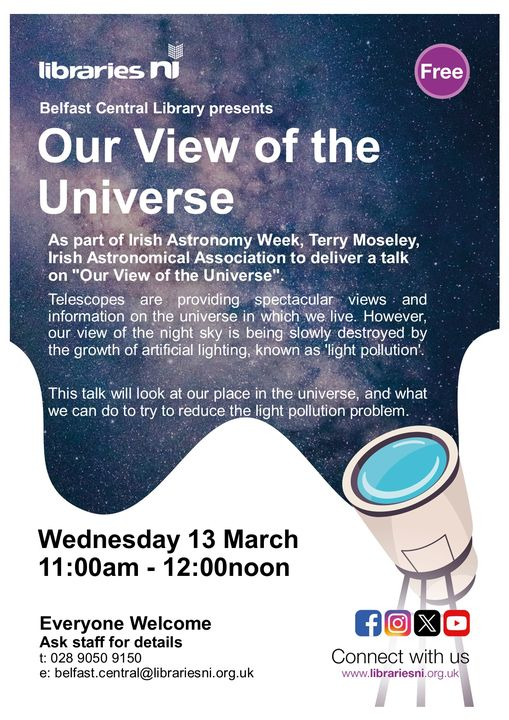
IAA LECTURE, Wed 6 March, 7.30 p.m. “Wind, storms and raining particles: Earth’s Space Weather ” by Dr Alexandra Fogg, Dublin Institute for Advanced Studies
With solar activity approaching a strong maximum, and last night’s aurora, this will be a fascinating and very timely lecture!
Biography:
Alexandra is a Space Scientist working at DIAS Dunsink Observatory in Dublin, a site of historical significance in Irish (and international) astronomy. She has always been passionate about science, technology, engineering and mathematics (STEM), and so completed her Physics degree with a specialism in space science and technology at the University of Leicester in 2016. With a passion for space physics, Alexandra completed a PhD on Earth’s Space Weather in 2020, which was a springboard for a career in space science.
Since 2020, Alexandra has worked in Dublin, researching primarily Earth’s Space environment and Space Weather through many different avenues. She has also explored similarities and differences with the space environments of different planets of the solar system.
In this talk, Alexandra will discuss the “winds”, “storms” and “rains” of Earth’s Space Weather. We will start at the centre of the Solar System, where the Sun’s atmosphere bubbles and streams out. This solar “wind” crashes into planets throughout the solar system, driving “stormy” conditions which in turn drive all kinds of dynamics. We will explore famous space weather storms throughout Earth’s history, and the impacts they have had on human technology. Finally, particles which “rain” down on the Earth’s atmosphere dramatically drive the Earth’s aurora: it’s Northern and Southern lights, and similarly driver aurorae throughout the Solar System.
VENUE: Larmor Lecture Theatre, Astrophysics Research Centre, Physics Building, QUB.
Admission free, including light refreshments, All welcome.
Observing Tonight Tues 5th March – Clandeboye
Hi all, there will be an IAA observing session at Clandeboye observatory tonight 5/3/24. Springtime galaxies are on the menu (if I can find them) using our 16” telescope. Start time is 7.30pm, all welcome!

Cosmic Corner Podcast Episode 7
What’s in the Night Sky for March?
Cosmic Corner is presented by Paul Evans, Sinéad Mannion, and Graham Sales. Highlights for March’s podcast include details on upcoming Irish Astronomy Week, more on irishastronomyweek.ie, and Midlands Astronomy event Cosmos, see midlandsastronomy.ie.
Solar Cycle 25 is very active so be on the lookout for Aurora, Paul will tell you the best times and websites to use. March skies make for a possible Mercury sighting, a rarity even for the most experienced astronomer and Graham updates us on the Japanese lunar lander, Slim …
Keep Looking Up!… Paul, Graham & Sinéad
Apple Podcasts
https://podcasts.apple.com/…/cosmic-corner/id1705184817…
Spotify
IAA LECTURE, Wed 7th February, 7.30 p.m. Dr Laura Scott, Armagh Observatory & Planetarium: “Heavy Metal Stars”
Synopsis:
Most stars are made of hydrogen and helium, with only tiny amounts of other elements. The ‘heavy metal stars’ are different – their atmospheres appear to be enriched in exotic heavy elements such as lead, zirconium and others. I will explain how the heavy metal stars differ from the norm, and what causes these elements to accumulate in their atmospheres.
Biography:
Laua is from England and did her masters in astrophysics at the University of Birmingham, before moving to Keele to do a PhD on convection in massive stars. Now she lives in Armagh and works at the Observatory, researching stellar atmospheres.
VENUE: Larmor Lecture Theatre, Astrophysics Research Centre, Physics Building, QUB.
Admission free, including light refreshments, All welcome.
Cosmic Corner February Podcast
What’s in the Night Sky for February? Cosmic Corner is presented by Paul Evans, Sinéad Mannion, and Graham Sales. Highlights for February’s podcast include details on upcoming Irish Astronomy Week, more on irishastronomyweek.ie, see dancing morning planets in our winter sky, Orion is still on display, Paul tells us about the Artemis slippage and find out how this week is historically a sad week for NASA. We discuss the sad demise of Ingenuity but how much it achieved going beyond its initial remit. Finally, Paul makes us super jealous of his new toy, the Seestar S50. … Keep Looking Up!… Paul, Graham & Sinéad
Spotify
Apple Podcasts
https://podcasts.apple.com/ie/podcast/cosmic-corner/id1705184817?i=1000643912445
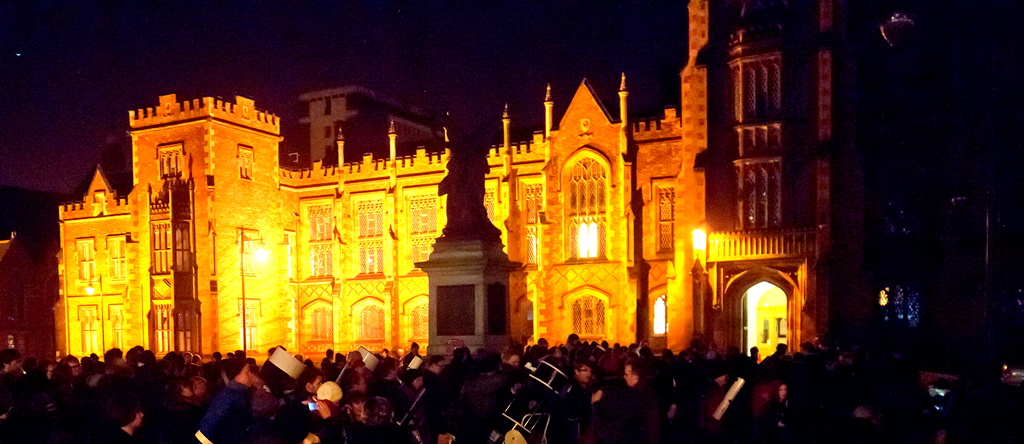
IAA Lecture, Weds 13th December – Two for the price of one (Free!)
Luke Majury –
Biography: I am Luke, a PhD student researching multi-wavelength observations of solar flares under Dr. Ryan Milligan. I have recently completed my first year of PhD study following the completion of an integrated master’s degree in astrophysics at QUB. Before starting an integrated master’s degree, I developed an interest in astronomy whilst undertaking a GCSE in the subject during my spare time under the tutelage of my secondary school physics teacher. My research currently revolves around comparisons of hydrogen Lyman-alpha and hard X-ray emissions during solar flares.
Synopsis/Abstract: Solar flares are among the most powerful events in our solar system. They occur due to the release of magnetic energy in the uppermost layer of the solar atmosphere. This process accelerates particles to high energies, with these energetic particles dissipating their energy via Coulomb collisions, resulting in a burst of electromagnetic radiation which we observe as a flare. Solar flares have been observed as early as 1859 during the Carrington event, since then great advances have been made in our understanding of flares via both observational and theoretical work. As we approach the peak of solar cycle 25 flares will become more frequent, allowing for abundant observations to be made with state-of-the-art observatories such as Solar Orbiter, Solar-C and the Advanced Space-Based Solar Observatory.
Thomas Moore
Title: Fast! Slow? Bright or Faint‽: exploring the diversity of supernovae
With the advent of large-scale robotic sky surveys, the number of supernovae we discover has ’exploded’. In this talk I will discuss what supernovae are, some of the history of their discovery and their incredible diversity.
I will also discuss the discovery, follow-up, and periodic signals of SN 2022jli – the most exciting supernova of the decade? (although I am biased).
Bio:
Thomas is a final year astrophysics PhD student at Queen’s University Belfast where he obtained an MSci in Physics with Astrophysics in 2021. His research focuses on observation and modelling of supernovae discovered by the ATLAS all-sky survey and spectroscopic observations using the ESO New Technology Telescope.
Venue: Larmor Lecture Theatre, Physics building, Queen’s University Belfast, 7.30 p.m.
Admission free, including light refreshments. All welcome.